


Since 26 May 2022, the IVDR has been fully applicable - including its Post-Market Surveillance (PMS) requirements. Yet many IVD manufacturers, especially those with legacy Class B, C, and D devices, may not realize that PMS obligations are already in force, regardless of their transition timelines.
While PMS isn’t new, the IVDR introduces far more rigorous and structured requirements than the IVDD ever did. These are not optional. They are legally binding and essential for maintaining certification.
Failure to comply can jeopardize your CE mark—even for legacy devices.
If you haven’t reviewed your PMS system recently, now is the time.
What does PMS under the IVDR involve?
Under IVDR, manufacturers must implement a device-specific PMS system that is fully integrated into their Quality Management System (QMS). This system must proactively and systematically collect and analyze data from:
- Serious incidents, Field safety corrective actions (FSCA), and Periodic safety update reports (PSURs)
- Non-serious incidents and undesirable side effects
- Trend reports and complaint data
- Scientific literature, databases, and registries
- Feedback from users, distributors, and importers
- Public information on similar devices
This data must be assessed using defined thresholds, indicators, and trending methods, and used to:
- Update the Benefit-Risk Determination, Design and Manufacturing Information, Instructions for Use and Labelling, Performance Evaluation (PE), and the Summary of Safety and Performance (SSP).
- Trigger Corrective and Preventive Actions (CAPA), needs for FSCAs, and options to improve usability, performance, and safety of the device.
- Contribute to the PMS of other devices (where applicable).
- Detect and report trends.
The process and methods for collection and analysis of PMS data are documented in the PMS plan together with methods and procedures for continuous update of the benefit-risk analysis and to manage any detected event such as CAPAs and FSCAs.
A new and important subset of PMS under the IVDR is Post-Market Performance Follow-up (PMPF). Stay tuned for part 2 of this blog to learn more about PMPF under the IVDR.
How to get started with PMS implementation
If you haven’t already, here’s how to begin:
1. Embed PMS into your QMS
Ensure your procedures cover Articles 78–81, Annex III, and Annex XIII Part B of the IVDR. Do not forget to establish links between PMS and Risk Management, CAPA, Performance Evaluation, and Summary of Safety and Performance (SSP).
2. Create PMS Templates for Deliverables
- PMS Plan (for all devices)
- PMS Report (Class A and B)
- PSUR (Class C and D)
- PMPF Plan or justification why it is not applicable
3. Define Data Sources and Collection Methods
As a starting point for the PMS Plan define and justify similar devices, based on the intended purpose of your device and consider PMS data that are already available.
4. Define Data Sources and Collection Methods
Include both reactive (e.g., complaints) and proactive (e.g., surveys, expert panels) data in your PMS plan. Consider optional sources like QC and production data.
5. Set Frequency and Responsibility
Define how often data is collected, who assesses it, and what infrastructure is needed. Identify indicators and threshold values for the assessment of the benefit-risk determination and link them to the risk acceptability criteria for your device and/or your risk management policy. Also include methods for trend detection, investigation of complaints.
6. Establish Communication Channels
Include methods for reporting to Competent Authorities, Notified Bodies, and Economic Operators.
Reporting requirements by Device Class
PMS results are reported in either a PMS Report (for Class A and B) or a PSUR (for Class C and D). Results of PMPF are reported in a PMPF Evaluation Report for all devices.
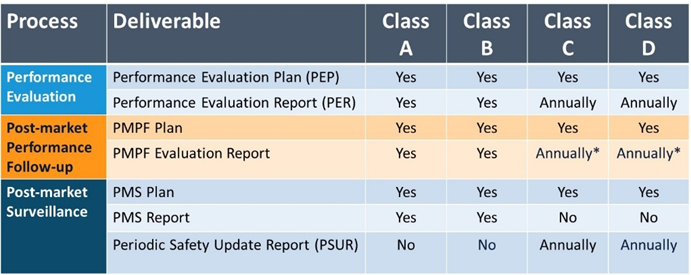
For class C and D devices the PSUR must be updated annually. This means the first PSUR must be issued 12 months after IVDR certification.
For class A and B devices the frequency for updating the PMS Report must be clearly defined in the PMS Plan and should be proportionate to the risk of the device. Higher-risk devices - such as those involving new technologies, significant patient impact, or those new to the manufacturer’s portfolio - may require more frequent updates.
Also note: regardless of class, additional updates may be needed in response to serious events, emerging risks, or performance issues.
What about IVDD legacy devices?
Even if your device is still certified under the IVDD, most PMS and PMPF requirements apply now. According to MDCG 2022-8:
- You don’t need to create SSPs or PMPF Evaluation Reports if they weren’t required under IVDD.
- You do need a PMS Plan and PMS Report.
- PSURs are not mandatory for legacy devices—but may be voluntarily adopted.
Final Thoughts: Don’t Wait
PMS is not a one-time task; it’s a continuous, resource-intensive process. It’s also a critical safeguard for your device’s market access and patient safety.
If you haven’t reviewed your PMS system since IVDR came into force, now is the time. Start by asking:
- Is PMS fully embedded in our QMS?
- Are our PMS Plans device-specific and risk-based?
- Are we collecting proactive data?
- Do we have the right infrastructure and resources?
Read part 2: Implementing Post-Market Performance Follow-up (PMPF) Under the IVDR: A Practical Guide